Work Case study
Marjin AI
London · via the Velocity partnership
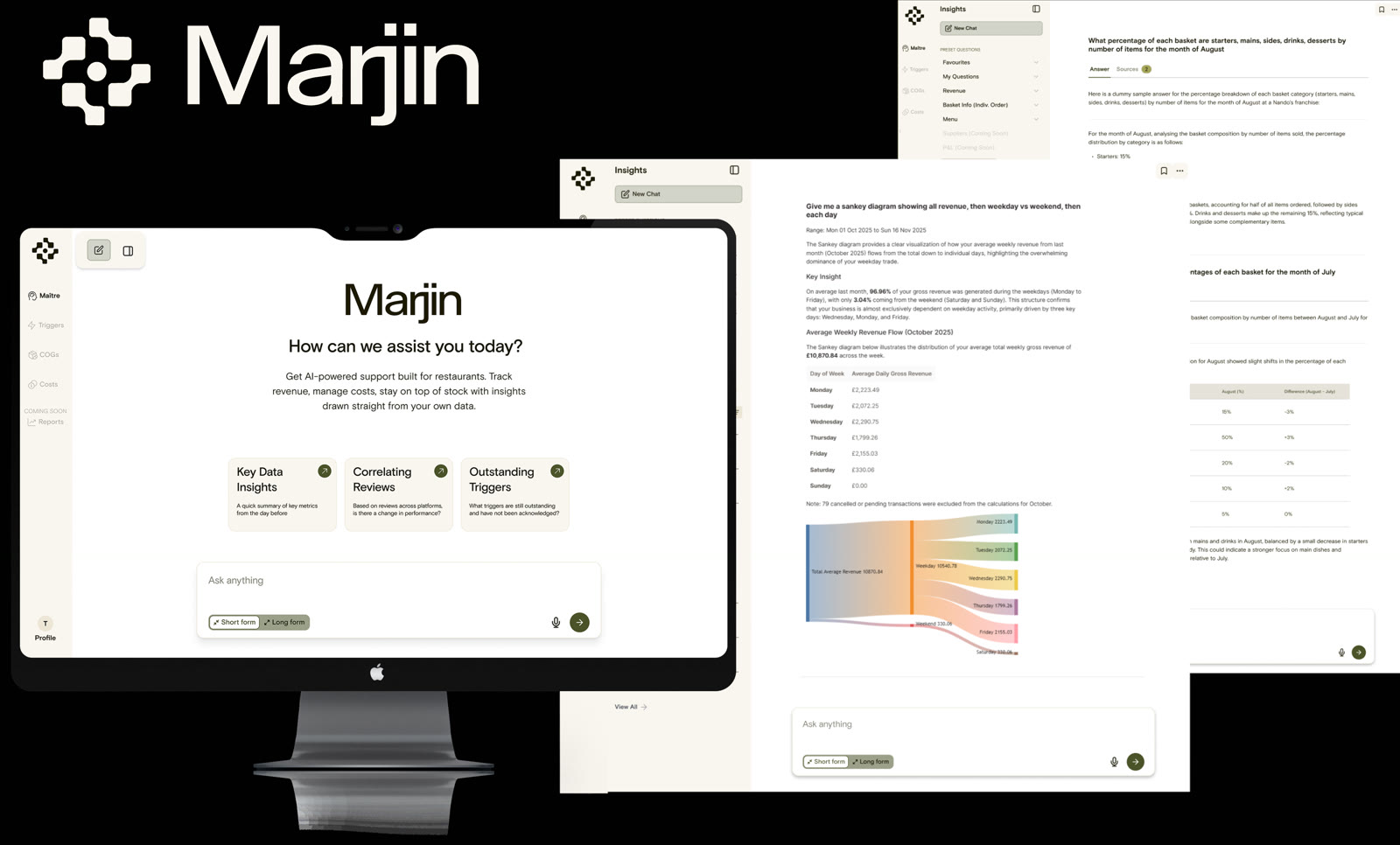
A hospitality data platform that pulls a restaurant group’s scattered sales, cost and operational data into one place, and lets its people ask questions of it in plain language.
- 11 months
- Of build, through to handover
- 336
- Commits on the engagement
- ~37
- Deno edge functions
- 3 layers
- Bronze, silver and gold data
The problem
The idea had already been validated with the market, and buyers were waiting to see it. Getting it built was the problem: a series of development teams had tried and none had shipped. The most recent attempt, built entirely in Lovable, left the business with an expensive prototype that tried to do a great many things and did none of them well.
The work started with an Intention Audit: a review of the existing system and every feature in it, measured against what the business was actually trying to achieve. From that came a narrow product and a roadmap ordered by priority, so a real application could reach potential clients as early as possible.
What I built
Two builds ran together: a data platform able to ingest hospitality data at national scale, and the application that turns it into answers.
-
Ingestion
An ETL pipeline with several routes in: API polling, webhooks and file polling, across EPOS tills, delivery platforms, finance systems and raw uploads, sized for groups running hundreds of sites.
-
Medallion data platform
Data lands in bronze, is cleaned and normalised through silver, and arrives in a gold layer modelled around the questions the business needs answered.
-
The application
Financial and business management on top of the pipeline: revenue and cost tracking, COGS, fixed costs, revenue targets and the operational picture across sites.
-
Maître, the assistant
A multi-agent LLM process that answers questions over sales, COGS and targets, tuned over time for accuracy, intelligence and cost together.
My role
One of the core engineers, not the sole builder, and client-facing throughout. Velocity led product development and design; One Eleven did the engineering.
I owned the COGS editor and its edge tooling, fixed costs, the revenue-targets engine and its evaluation cron, the Deliverect and Zonal ingestion and canonical order refresh, and the cost and target tools Maître calls.
Key decisions
-
The AI only reads gold
The application and its AI features query the gold layer only, so every insight is drawn from one consistent, trustworthy view of the data.
-
Questions become queries
The model translates a question into a database query and reasons over a small result set rather than raw data. Caching means a repeated question never pays for inference twice.
-
Narrow before wide
The roadmap cut the prototype’s sprawl down to a few features worth building well, and made every feature after that earn its place.
Outcome
- Sales mode
- The founders now manage a sales pipeline instead of a development effort.
- In-house team
- Internal engineers were hired and trained, and now own the platform.
- Costs that hold
- An AI layer tuned so each answer stays cheap to produce as usage grows.
One Eleven takes your app idea and quickly turns it into a solid plan, delivering top-notch results fast, and keeping you part of the process throughout.